
Beyond volume: How HA dermal fillers may support skin rejuvenation from within.
As a physician, I often meet patients who think of dermal fillers as a way to “fill in” a wrinkle or replace lost facial volume. That is understandable. Hyaluronic acid, or HA, fillers are best known for their ability to restore structure, soften certain folds, and bring more balanced contours to areas such as the cheeks, lips, chin, jawline, temples, under-eyes, and hands.
But the science behind HA fillers is more interesting than simple space filling.
The most predictable effect of HA filler is still immediate structural support. When placed thoughtfully, filler can restore volume, improve contour, and create smoother transitions between facial areas. However, research also suggests that certain cross-linked HA filler techniques may do more than provide temporary volume. In specific skin samples studied, cross-linked HA has been associated with collagen-related remodeling, fibroblast activity, and changes in the skin’s extracellular matrix.
That does not mean every filler treatment is collagen-stimulating. It also does not mean HA fillers work the same way as Sculptra or other dedicated biostimulatory injectables. The better way to understand the evidence is this: HA fillers are primarily structural treatments, and some studies suggest they may also create a healthier mechanical environment in the skin that supports collagen-related activity.
AT A GLANCE
- HA fillers are primarily structural — their most predictable benefits are immediate volume, contour, and support.
- In specific studied contexts, cross-linked HA has been associated with collagen-related remodeling and fibroblast activity.
- HA fillers are not the same as Sculptra — a dedicated collagen-stimulating injectable. They are different tools.
What HA Dermal Fillers Do Immediately
Hyaluronic acid is a substance naturally found in the body, including in the skin, joints, and connective tissue. In aesthetic medicine, HA fillers are formulated as cross-linked gels so they provide structure after injection rather than simply disappearing into the tissue right away.
The first visible effect is usually volume and support.
Depending on the treatment area, HA filler may be used to soften folds, restore cheek volume, improve lip shape, support the chin or jawline, reduce certain hollow-looking shadows, or create smoother transitions between facial areas. This is why filler treatment is often less about “filling a line” and more about restoring the support that gives the face a balanced, rested appearance.
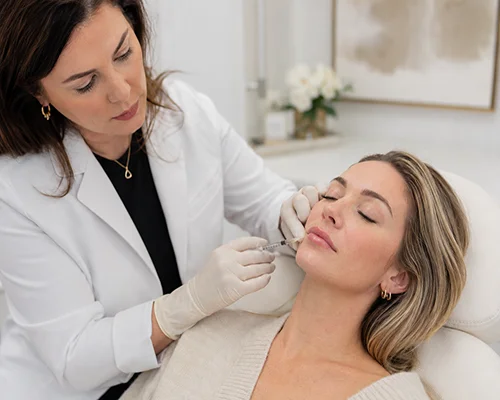
For example, a cheek that has lost volume may make the lower face look heavier. A shadow under the eye may appear more noticeable when the surrounding midface support has changed. A fold around the mouth may appear deeper because the surrounding tissue has thinned or shifted.
Good filler treatment takes all of this into account. The goal is not simply to place the product where a wrinkle appears. The goal is to understand facial anatomy, movement, proportions, and the way aging has changed the underlying support system.
That is why physician-led filler planning matters. Product choice is important, but so are placement, depth, amount, facial balance, and the patient’s overall anatomy.
The Skin’s Internal Support System
To understand how HA fillers may influence the skin beyond volume, it helps to look below the surface.
The skin has an internal framework called the extracellular matrix. This matrix includes collagen, elastin, hyaluronic acid, and other structural components that help give skin its strength, flexibility, hydration, and resilience.
Collagen is one of the main support proteins in the skin. It helps provide firmness and structure. Elastin contributes to the skin’s ability to stretch and return to shape. Hyaluronic acid helps with hydration and tissue support.
Fibroblasts are the cells that help maintain this system.
These cells produce collagen and other components of the extracellular matrix. In younger, healthier skin, fibroblasts are typically stretched within a more intact collagen framework. That physical shape matters because fibroblasts respond to their mechanical environment. When they are well supported and properly stretched, they tend to behave more actively.
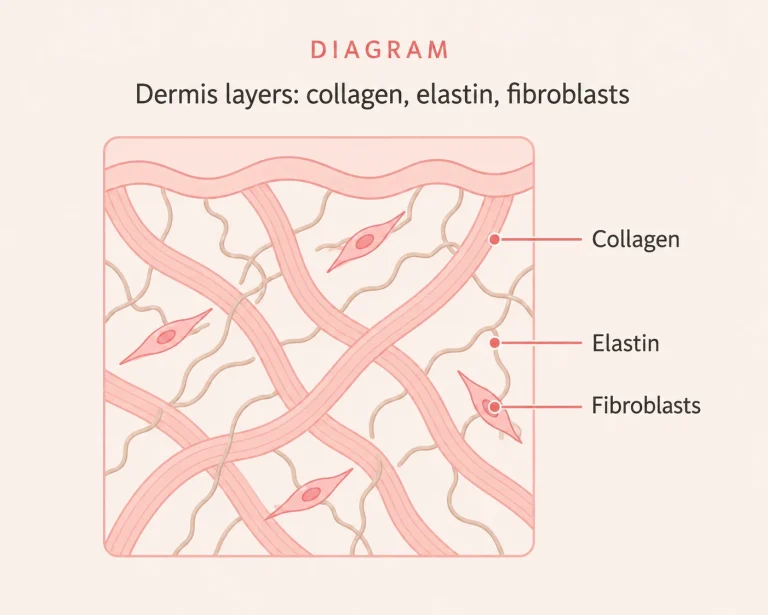
Over time, that support system changes. Aging, sun exposure, inflammation, and other environmental stressors can fragment the collagen framework. As that framework weakens, fibroblasts may lose some of the tension and support that help them function well.
Instead of remaining stretched and active, they can become more collapsed and less productive.
This is one reason aging skin can become thinner, less firm, and less resilient. The issue is not only that the skin has less collagen. The deeper issue is that the skin’s structural environment becomes less capable of supporting healthy repair and maintenance.
The Mechanical Support Theory
One of the more interesting areas of HA filler research focuses on mechanical support.
Cross-linked HA filler occupies space in the tissue. That is what creates the immediate volumizing and contouring effect. But researchers have also explored whether this physical support may influence nearby fibroblasts.
The proposed idea is that cross-linked HA may help restore mechanical tension in the dermis. When the filler creates support within the tissue, nearby fibroblasts may regain a more stretched, active shape. This may encourage them to produce more collagen and other extracellular-matrix components.
This does not mean the filler is magically turning the skin back to its youth. It means that, in certain studied contexts, the physical presence of HA appears to influence the behavior of skin cells. A careful way to say this is:
“Cross-linked HA may provide mechanical support that appears to help stretch and activate fibroblasts in treated skin.”
What the Research Shows
Several studies have looked at whether cross-linked HA fillers can influence collagen production and skin remodeling.
One important area of research involves photodamaged skin, meaning skin that has been affected by long-term sun exposure. In this type of aged skin, the collagen framework is often fragmented, and fibroblasts may be less active.
Reported de novo (new) collagen production after cross-linked HA filler injection in photodamaged human skin — often cited for establishing that HA fillers may do more than merely occupy space.
A review supporting the concept that cross-linked HA can fill space while also influencing dermal fibroblasts and collagen production in aged or photoaged skin.
A small human skin study of repeated intradermal microinjections of small-particle cross-linked HA into photoaged forearm skin. Found changes consistent with remodeling: collagen staining, fibroblast activity, extracellular-matrix-related gene expression, and some improvements in skin-quality measurements.
That last study is promising, but the context matters. It did not study every type of facial filler placement. It did not prove that standard cheek, lip, chin, jawline, or under-eye filler treatments all produce the same biological effect. It studied a specific intradermal HA protocol in photoaged forearm skin.
That distinction is important for honest patient education.
The safest conclusion is not “all fillers stimulate collagen.” The safer conclusion is that certain cross-linked HA techniques have been associated with collagen-related remodeling in human skin samples studied, especially when placed intradermally in repeated skin-rejuvenation-style protocols.
What Patients May Notice
-
Softer folds or shadows
-
More balanced lip shape or volume
-
Smoother transitions between facial areas
-
More natural facial balance
-
Improved cheek support
-
Better chin or jawline definition
-
A less tired or hollow appearance\
Any longer-term skin-quality effect should be discussed more carefully. Some patients may experience changes that feel like improved firmness, hydration, or skin texture, especially when HA is used in more superficial or skin-quality-focused protocols. But this should not be promised as a guaranteed effect.
The immediate structural result comes from the filler itself. The possible collagen-supporting effect, when it occurs, is secondary, more gradual, and more dependent on the treatment technique, product, depth, patient biology, and treatment area.
This is why filler planning should be individualized. Two patients may both receive HA filler, but their goals, anatomy, skin quality, product selection, and injection depth may differ significantly.

HA Fillers Are Not the Same as Sculptra
Primarily restore volume, structure, and contour with an immediate visible effect. Many HA fillers are also reversible with hyaluronidase, depending on the product and clinical situation.
Made from poly-L-lactic acid and used as a dedicated collagen-stimulating injectable. Rather than creating immediate volume, Sculptra gradually encourages the body to build collagen over time.
That does not make one treatment better than the other. It makes them different tools.
For some patients, HA filler is the right choice because the main issue is volume loss, contour, or structural support. For others, Sculptra may be a better fit when the goal is broader collagen stimulation over time. In some treatment plans, both may have a role, but they should not be described as doing the exact same thing.
A good consultation helps determine which tool fits the anatomy, timeline, and goal.
Why Injector Expertise Matters
Even when we are talking about collagen science and skin quality, it is important to remember that dermal fillers are medical procedures.
HA fillers are commonly performed and generally well tolerated when used appropriately, but they are not risk-free. Temporary swelling, bruising, tenderness, redness, itching, or firmness can occur after treatment. Less common complications may include nodules, inflammation, infection, or product-related concerns.
The science of HA fillers is fascinating, but safety still comes first. Product choice matters. Injection depth matters. Anatomy matters. Judgment matters.
At Aluma, filler treatment is approached as a medical aesthetic procedure, not a quick cosmetic shortcut. The goal is to use the right product, in the right place, for the right reason.
The Bottom Line
So, do dermal fillers stimulate collagen?
The most accurate answer is: sometimes, in specific studied contexts, cross-linked HA fillers appear to support collagen-related remodeling. Research suggests that certain HA techniques may provide mechanical support in the dermis, influence fibroblast activity, and contribute to extracellular-matrix changes in treated skin samples.
But HA fillers should still be understood primarily as structural and volumizing treatments. Their most predictable benefits are immediate support, contouring, and softening of volume-related changes. Any collagen-supporting effect should be described carefully, with the understanding that the evidence depends on product type, technique, depth, treatment area, and patient biology.
For patients, this is good news, but it should be framed responsibly. HA filler is not just about “filling a line.” In skilled hands, it can be part of a thoughtful facial rejuvenation plan that supports structure, balance, and a refreshed appearance.
If you are considering dermal fillers, the best starting point is a consultation. A physician-led assessment can help determine whether HA filler, Sculptra, or another treatment approach is the best fit for your anatomy, goals, and timeline.
Frequently Asked Questions
Do HA dermal fillers stimulate collagen?
Research suggests that certain cross-linked HA filler techniques may support collagen-related remodeling in studied skin samples. However, this should not be interpreted to mean that every HA filler treatment produces new collagen in every patient.
Are HA fillers the same as Sculptra?
No. HA fillers are primarily structural and volumizing treatments that provide immediate support and contour. Sculptra is a poly-L-lactic acid injectable that gradually stimulates collagen production.
Can dermal fillers improve skin quality?
Some intradermal HA protocols have been associated with improvements in skin-quality measurements, such as texture, hydration, and elasticity, in the studied skin. However, the most predictable benefits of traditional HA filler treatment remain volume restoration and structural support.
Are HA fillers reversible?
Many HA fillers can be dissolved with hyaluronidase, depending on the product and treatment situation. This is one reason HA fillers are often chosen for certain areas and treatment plans.
Are dermal fillers safe?
Dermal fillers are widely used, but they are medical treatments with real risks. Temporary swelling, bruising, redness, tenderness, and itching can occur. Rare but serious vascular complications are possible, which is why the filler should be placed by a trained medical injector with strong anatomical knowledge.
Bibliography
Cui, Yilei, et al. “Rejuvenation of Aged Human Skin by Injection of Cross-linked Hyaluronic Acid.” Plastic and Reconstructive Surgery, vol. 147, no. 1S-2, 2021, pp. 43S–49S.
FDA. “Dermal Fillers Soft Tissue Fillers.” U.S. Food and Drug Administration.
FDA. “Information for Health Care Providers About Dermal Fillers.” U.S. Food and Drug Administration.
Hsieh, Daniel Meng-Yen, et al. “In Vivo Investigation of the Biostimulatory and Rejuvenating Effects of Small-Particle Cross-linked Hyaluronic Acid Injections in Photoaged Human Skin.” Aesthetic Surgery Journal, vol. 43, no. 5, 2023, pp. 595–608.
Wang, Frank, et al. “In Vivo Stimulation of De Novo Collagen Production Caused by Cross-linked Hyaluronic Acid Dermal Filler Injections in Photodamaged Human Skin.” Archives of Dermatology, vol. 143, no. 2, 2007, pp. 155–163.
