

Today, there are more dermal filler options available than ever before, and selecting the right one is only a very small part of the equation. Achieving beautiful, natural results requires a detailed understanding of facial shape, anatomy, age-related changes, product selection, and injection technique.
Why Face Shape Matters
Have you ever chosen a pair of sunglasses or a hairstyle based on your face shape? The same principle applies to dermal fillers. Each face shape has distinct characteristics that influence the depth filler should be placed, which products should be selected, and which features should be enhanced or supported.
The Heart-Shaped Face
Full cheeks and a narrow lower face that tapers to the chin. With age, this shape often loses volume and support in the mid-face, creating a more angular, skeletal appearance.
Restore support through the mid-face while softening and balancing the lower third. Volume in the cheeks and sub-cheek area smooths the transition from upper to lower face.

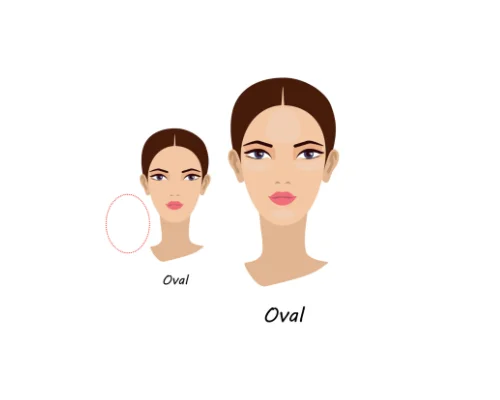
The Oval-Shaped Face
Often considered the most balanced shape, softly curved contours and a broader midface tapering gently toward the chin. Aging tends to bring under-eye hollowing and softening of the jawline.
Restore midface and temple support. Lateral and medial cheek fillers create a subtle lift and support the undereye area. Temple filler rejuvenates the oval shape from forehead to chin, softening nasolabial folds and under-eye shadows.
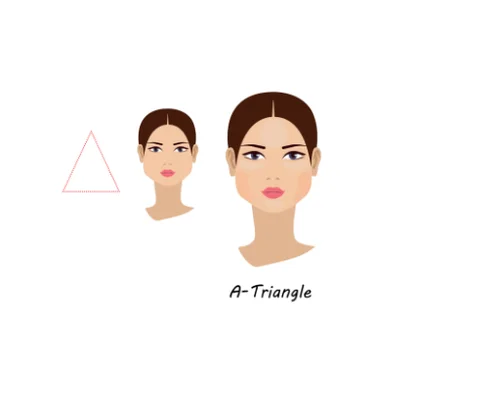
The Triangular Face
Defined by a strong, well-defined jawline and greater width in the lower third. It tends to age gracefully, but loss of cheek volume can make the face appear heavy, saggy, and prematurely aged.
Restore balance between the upper and lower thirds while preserving the defined jaw angle. Begin by volumizing the midface. Then refine along the jawline and mandibular angle if structural loss is noted.
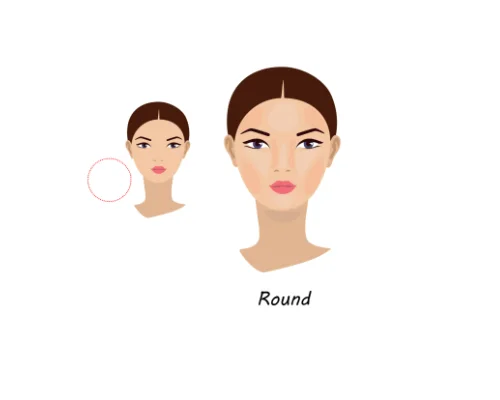
The Round Face
Full cheeks and a gently rounded jawline with a shorter lower third of the face, from lip corners to chin. As aging occurs, nasolabial folds become more noticeable, often the earliest complaint for this shape.
Enhance cheek definition and balance the face’s horizontal and vertical dimensions. Lateral cheek placement defines the cheekbones and lifts the jawline, while chin filler can add proportional vertical length.
How Filler Properties Influence Outcomes
An experienced injector looks beyond the name on the syringe. They consider how the gel behaves once placed in tissue. This is rheology: the study of how materials flow and respond to applied forces.
Support
Matters when mimicking bone for structural replacement or deep volume loss – cheeks, chin, jawline, temples. Firmer products resist compression.
Flexibility
Essential in mobile areas that need a soft finish: the lips, lines around the mouth, and the under-eye region. A stiff product here can look unnatural.
Cross-linking
Affects longevity and behavior. More cross-linking can improve how long a filler lasts, but may make it firmer or harder to dissolve.
Cohesivity
How strongly the gel sticks to itself. Highly cohesive fillers hold their shape; less cohesive ones spread more easily through tissue.
HA Concentration
Higher concentrations attract and retain more water – ideal for temple volume or lip hydration, but not for the tear trough, where excess water can cause puffiness.
How Age Changes Filler Planning
Age is not the only factor, but it helps to consider before injecting. The goal in your 20s is usually very different from the goal in your 40s or 50s.
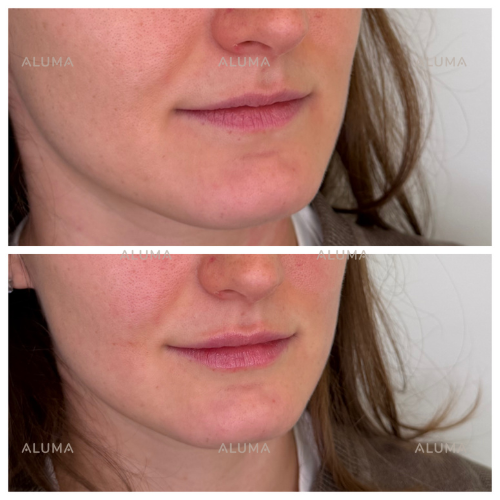

Choosing Filler Based on Goals
Why Different Areas Need Different Fillers
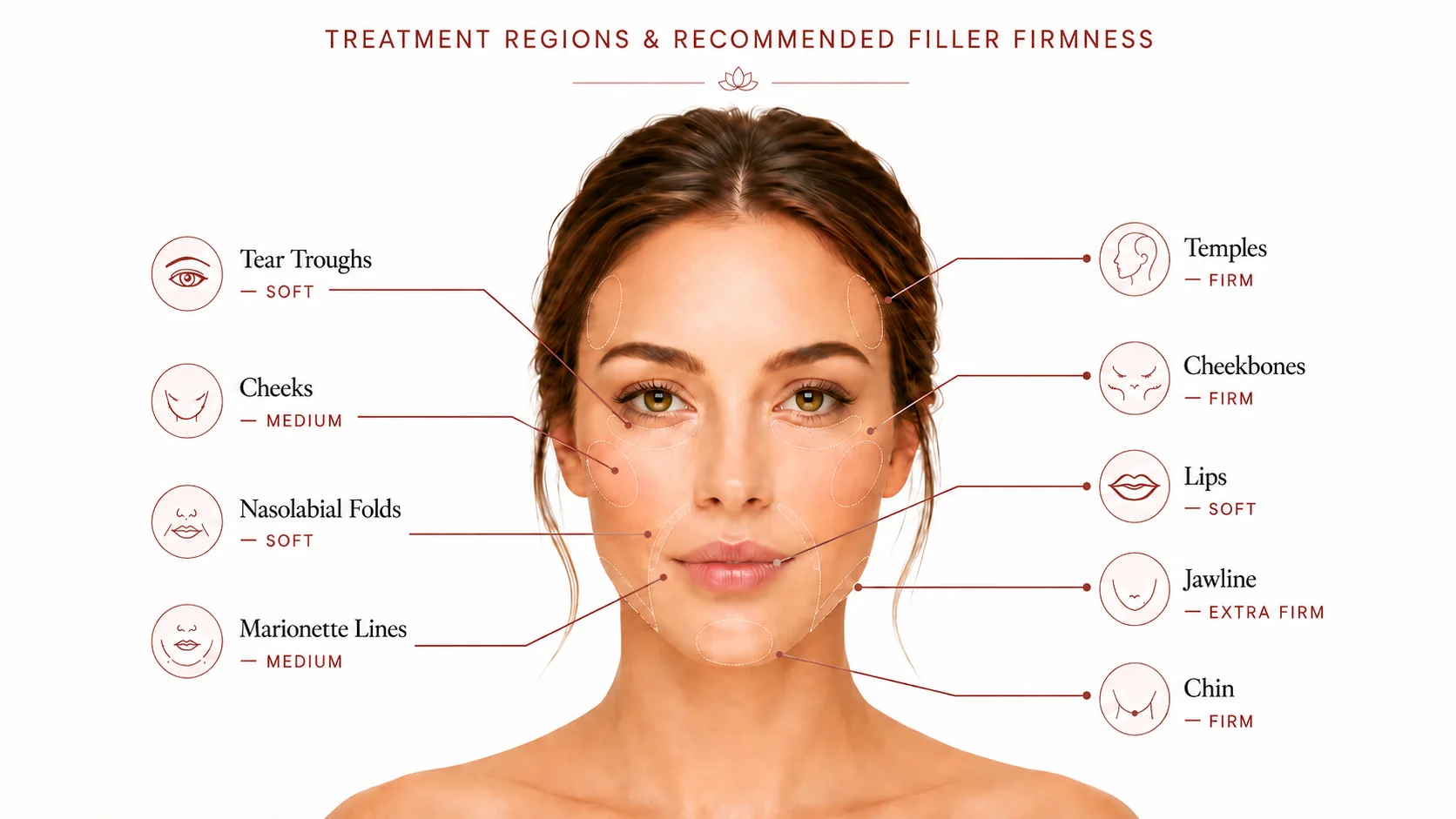
Soft, smoothly integrating, and naturally mobile. Constantly in motion, so a product too firm can feel stiff or look unnatural.
Structural support. Placed deep along the cheekbone with a firmer, cohesive product to restore projection and lift the lower face.
The chin needs structure that still allows natural motion; temples benefit from a supportive, water-binding filler to restore smooth volume.
Flexible, smooth, and minimally water-attracting. The thin skin here can puff if a filler draws too much water — subtle correction is the goal.
Both a firmer filler placed deep for projection and a flexible filler in the subcutaneous plane to restore lost volume.
A firmer filler that mimics bone and creates clean, defined contours along the mandible.
A Medical Procedure, Not a Beauty Service

How Aluma Creates a Plan for You
Bibliography
Shah, Rohan, et al. "Current Landscape of Hyaluronic Acid Filler Use in the United States." Journal of Drugs in Dermatology, vol. 23, no. 1, Jan. 2024.
Rohrich, Rod J., Erica L. Bartlett, and Erez Dayan. "Practical Approach and Safety of Hyaluronic Acid Fillers." Plastic and Reconstructive Surgery Global Open, vol. 7, no. 6, 2019.
Fundarò, Salvatore Piero, et al. "The Rheology and Physicochemical Characteristics of Hyaluronic Acid Fillers." International Journal of Molecular Sciences, vol. 23, no. 18, 2022, article 10518.
Taylor, Drew, et al. "A.S.S.E.S.S. for Facial Fillers." Journal of Cosmetic Dermatology, 2024.
