

One of the most common things people notice as they age isn’t a single wrinkle or fold — it’s a quiet shift in how the whole face looks. The skin seems thinner, the cheeks a little flatter, and the overall appearance more tired, even on a well-rested day. That change isn’t imagined. It’s a result of a steady, biological decline in collagen — the protein that gives your skin its structure, firmness, and bounce.
Beginning in our 30s and accelerating into our 40s and beyond, collagen production drops significantly.[1] Sculptra is one of the few aesthetic treatments designed to address this loss at its source, by stimulating your body to make new collagen of its own. The result is gradual, natural-looking rejuvenation that builds over months and lasts for years.
TREATMENT OVERVIEW
What Is Sculptra?
Sculptra is a biostimulatory injectable made from poly-L-lactic acid, or PLLA. PLLA is a synthetic, biocompatible, biodegradable polymer that has been used safely in medicine for more than 50 years — it was first introduced in the 1970s as the material used in absorbable surgical sutures. Its safety profile is well established, and the polymer gradually breaks down into lactic acid, a substance your body metabolizes naturally.
Sculptra arrives at the clinic as a powder and is reconstituted with sterile water before treatment. At Aluma, we also add lidocaine at the time of reconstitution to make the injection more comfortable.
Unlike traditional filler, Sculptra has no inherent volume when it’s injected. It works by signaling your own body to build new collagen, restoring structure and firmness over time.
How Does Sculptra Work?
Sculptra’s active ingredient is PLLA microparticles, suspended in sterile water at the time of treatment. The product is most often injected with a blunt-tipped cannula into the deep dermis or superficial subcutaneous tissue. In certain areas, such as over the cheekbone, it can also be injected with a needle into a deeper plane just above the bone.
After injection, the sterile water is absorbed by the body over the first two to three days, and the PLLA microparticles remain in the tissue. Those microparticles trigger a controlled, low-grade tissue response that activates fibroblasts — the cells responsible for making collagen. Over the following weeks and months, the PLLA particles are slowly broken down and eliminated as lactic acid, while new collagen continues to form.
Clinical studies have shown that PLLA stimulates the production of Type I collagen, the primary structural collagen responsible for firmness, as well as Type III collagen, which supports early tissue repair and overall skin quality.[1][2] One NIH-indexed review reported that Type I collagen levels increased by 65.5% three months after a single subdermal PLLA-SCA treatment.[4]
The final result isn’t instant filling. It’s a gradual improvement in the structure, thickness, and resilience of your skin, with a subtle amount of added volume.
WHAT TO EXPECT
When Will I See Sculptra Results?
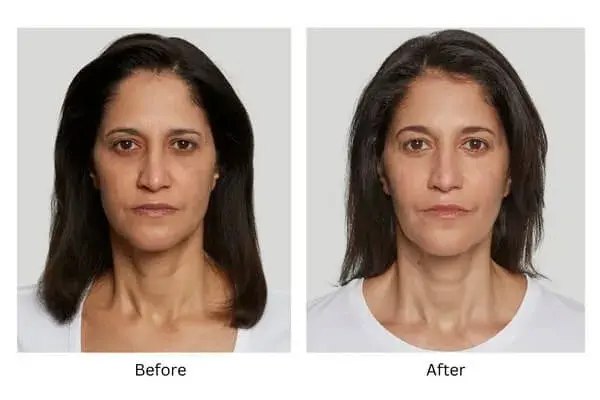
Sculptra results build slowly. In the first few days after treatment, the sterile water is absorbed and the treated area can look similar to how it appeared pre-treatment. That’s normal, and often surprising for patients who are used to the immediate effect of hyaluronic acid fillers. Behind the scenes, however, the PLLA microparticles are silently signaling your body to ramp up collagen production.
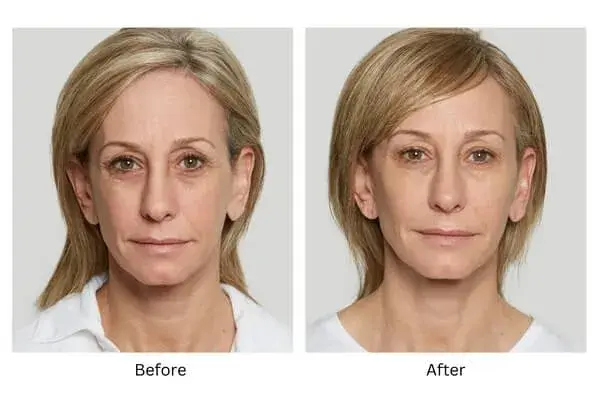
Most patients begin to notice visible improvement around 8 to 12 weeks after treatment, with continued improvement over the following months. Because the changes are gradual, it’s easy to underestimate how much has actually shifted. We strongly recommend taking pre-treatment photos, follow-up photos at 8 weeks, and a final set about 12 weeks after your second treatment so you can see the progression clearly.
Sculptra produces a subtle, natural-looking rejuvenation — not the immediate change in lift or contour you’d see after a dermal filler injection.
How Long Does Sculptra Last?
How Many Sculptra Treatments Will I Need?
Most patients need a series of treatments to achieve optimal support and volume. A common starting point is 2 vials, with additional sessions spaced about 6 to 8 weeks apart. The makers of Sculptra offer a general guideline of approximately one vial per decade of age, while emphasizing that treatment should always be tailored to the individual patient’s concerns and goals.
A general dosing guide:
- 20s — often 2 vials
- 30s — often 3 vials
- 40s — often 4 vials
- 50s and beyond — often 5+ vials
What Areas Can Sculptra Treat?
Sculptra is most commonly used for facial rejuvenation, particularly where collagen loss contributes to sagging, hollowing, or folds. Common treatment areas include:
- Fine lines, wrinkles, and crepey skin throughout the face
- Sunken temples
- Cheek and midface support
- Smile lines and nasolabial folds
- Lower-face volume loss and skin laxity
- Jawline structure and definition
- Overall skin firmness and facial harmony
Use of Sculptra outside the face — for example, in the neck — is considered off-label at this time. Your provider can discuss whether any of these uses may be appropriate for you.
COMPARING YOUR OPTIONS
Is Sculptra the Same as Dermal Filler?
Sculptra is often grouped with dermal fillers because both treatments are injected and both can improve volume and support — but the way they work is fundamentally different.
Traditional hyaluronic acid (HA) fillers are injected as a viscous gel that adds immediate volume and contour. They attract water, plump the tissue, and physically fill depleted areas. Sculptra, by contrast, has no inherent volume at the moment of injection. It’s a biostimulator, meaning it works at the cellular level to stimulate collagen production over time. While HA fillers can induce some collagen as a secondary effect, they are not classified as biostimulators.
Another important difference: Sculptra cannot be reversed the way an HA filler can. HA fillers can be dissolved using hyaluronidase, an enzyme that breaks down hyaluronic acid. Sculptra, on the other hand, is gradually absorbed and metabolized out of your body over time.
| Factor | Sculptra (Biostimulator) | Hyaluronic Acid Filler |
|---|---|---|
| How it works | Stimulates your body to produce new collagen | Adds immediate volume with a gel that attracts water |
| Onset of results | Gradual — typically visible at 8 to 12 weeks | Immediate |
| Duration | Up to 2 years | Typically 9 to 18 months, depending on product and area |
| Reversible | No — metabolized over time | Yes — dissolvable with hyaluronidase |
| Best for | Overall skin thickness, structural support, firmness, gradual rejuvenation | Targeted contouring, lip volume, immediate correction of folds and hollows |
| Treatment plan | Series of 2 to 3 sessions, 6 to 8 weeks apart | Usually a single appointment, with touch-ups as needed |
WHAT THE RESEARCH SHOWS
65.5%
Increase in Type I Collagen at 3 Months
< 1%
Modern Nodule Rate
Up to 2 yrs
Typical Duration of Results
Sources: NIH-indexed review of PLLA-SCA outcomes[4]; multicenter retrospective chart review of 4,400+ treatments using current reconstitution protocols[7].
SAFETY & SIDE EFFECTS
Is Sculptra Safe?
Sculptra has been studied extensively and has a long history of medical and aesthetic use. Like all injectable treatments, however, it does carry some risk. The most common side effects are swelling, redness, bruising, tenderness, and temporary lumps at the injection site.
Rare, more serious risks can include papules, granulomas, infection, discoloration, vascular complications, and other inflammatory reactions. As with any injectable, one of the most important ways to reduce these risks is to choose a qualified, experienced medical injector who understands facial anatomy and product placement.
Can Sculptra Cause Lumps or Nodules?
This is one of the most common questions we get, and it has an interesting history. In Sculptra’s earlier years, when the product was reconstituted with only 3 to 5 mL of sterile water, subcutaneous nodules and small collections of collagen were a known issue. Modern protocols, approved by the FDA, now call for 8 mL of sterile water, which has dramatically reduced the incidence of nodules.
A multicenter retrospective chart review of more than 4,400 treatments using 7 to 10 mL reconstitution volumes confirmed a favorable safety profile, with a nodule rate of just 0.4%.[7] In current practice, nodules occur in less than 1% of patients.
What Is the Aftercare for Sculptra?
The most commonly recommended aftercare routine is the “5-5-5” massage rule: massage the treatment area for 5 minutes, 5 times a day, for 5 days. Some providers use a “3-3-3” version, but at Aluma we prefer the more thorough 5-5-5 approach.
Massage helps distribute the product evenly, supports the inflammatory response that drives collagen production, and may help reduce the risk of small lumps. Some mild redness or tenderness after massage is to be expected and resolves quickly.
Does Sculptra Hurt?
Most patients tolerate Sculptra well. At Aluma, lidocaine is added to the product at the time of reconstitution, and a blunt-tipped cannula is used for most injections rather than a sharp needle, both of which significantly improve comfort. We also recommend taking Tylenol (acetaminophen) about 45 minutes before your appointment.
IS SCULPTRA RIGHT FOR YOU
Who Is a Good Candidate for Sculptra?
At Aluma, we believe the mid-to-late 30s is the “sweet spot” for starting Sculptra. By age 40, most individuals have lost up to 20% of their natural collagen.[8] Beginning treatment in this window allows us to replace what has been lost while also building reserves for the future.
That said, Sculptra is appropriate for a wide range of ages and concerns. Older patients with more advanced volume loss often benefit just as much — and sometimes more — because the structural changes Sculptra creates can refresh the entire face. The best way to determine whether Sculptra is right for you is a personalized consultation, where we can assess your skin, your facial structure, and your goals.
Sculptra is technique-sensitive. It should be performed by an experienced medical injector who understands facial anatomy, product placement, patient selection, and complication prevention.
WHY ALUMA
Why Choose Aluma Aesthetic Medicine for Sculptra in Portland?
At Aluma Aesthetic Medicine in Portland, Oregon, Sculptra treatments are customized to support natural facial balance, refreshed volume, and long-term skin quality. Dr. Brigham uses both cannula and needle techniques, choosing the approach that best matches each treatment area and each patient’s anatomy.
Our philosophy is rooted in education, safety, and gradual, natural results. We believe the best outcomes come from honest conversations about what Sculptra can and cannot do, realistic timelines, and a customized plan that may combine biostimulators with other treatments when appropriate.
FREQUENTLY ASKED QUESTIONS
How is Sculptra different from a Dermal Filler?
Dermal fillers add immediate volume because they’re injected as a hydrating gel. Sculptra is a biostimulator that has no inherent volume at injection — instead, it triggers your body to produce new collagen over time. Fillers can also be dissolved if needed, while Sculptra is gradually metabolized and cannot be reversed.
When will I see results?
Most patients begin to notice visible improvement around 8 to 12 weeks after their first treatment, with continued improvement over the following months as more collagen is produced.
How long do Sculptra results last?
Results can last up to 2 years for many patients, depending on age, metabolism, lifestyle, and the number of vials used.
How many treatments will I need
Most patients benefit from a series of 2 to 3 treatments, spaced 6 to 8 weeks apart. The total number of vials depends on your age, the degree of collagen loss, and your goals.
Does Sculptra cause lumps?
With modern reconstitution protocols (8 mL of sterile water) and a diligent post-treatment massage routine, the rate of nodules is under 1%. A large multicenter review reported a nodule rate of just 0.4%.
Is Sculptra painful?
Most patients tolerate Sculptra well, especially with lidocaine added to the product, the use of a cannula rather than a needle, and pre-treatment Tylenol.
When is Sculptra not the right choice?
Sculptra isn’t ideal when you need immediate volume for a specific event, when you want a result that can be dissolved or reversed, or when the area of concern is best addressed by a different treatment such as dermal filler, neuromodulators, or surgery. A consultation is the best way to determine the right fit.
Conclusion
Sculptra is one of the most powerful tools we have for addressing the underlying cause of facial aging — collagen loss — rather than simply masking its symptoms. When performed by an experienced injector and supported by a thoughtful treatment plan, it delivers gradual, natural-looking rejuvenation that can last for years.
At Aluma Aesthetic Medicine, our approach to Sculptra is rooted in education, anatomy, and individualized care. Whether your plan ends up being Sculptra alone, Sculptra combined with other treatments, or a different approach entirely, our goal is to guide you toward the option that truly serves your anatomy and your best outcome.
REFERENCES
- Fitzgerald R, et al. Poly-L-lactic acid for facial rejuvenation: histologic and clinical evaluation. PMC10286875.
- Narins RS, et al. Long-term safety and efficacy of poly-L-lactic acid in facial aesthetics. PMC11743305.
- Vleggaar D, Fitzgerald R. Dermal filler complications and their management. PMC4809477.
- Goldberg D, Guana A, Volk A, Daro-Kaftan E. Dermatological Surgery, 2013; 39(6): 915–922. Carruthers J, Humphrey S. Injectable Soft Tissue Fillers: Temporary Agents, 2022 update.
- Athanasiou KA, Niederauer GG, Agrawal CM. Sterilization, toxicity, biocompatibility and clinical applications of polylactic acid/polyglycolic acid copolymers. Biomaterials. 1996. PMC2852004.
- Galderma. Sculptra eIFU. galderma.com/us/sites/default/files/2023-04/Sculptra_USA_eIFU.pdf
- Palm M, Mayoral F, Rajani A, Goldman MP, Fabi S, Espinoza L, Andriopoulos B, Harper J. Chart Review Presenting Safety of Injectable PLLA Used With Alternative Reconstitution Volume for Facial Treatments. J Drugs Dermatol. 2021 Jan 1;20(1):118–22.
- Shuster S, Black MM, McVitie E. The influence of age and sex on skin thickness, skin collagen, and density. Br J Dermatol. 1975;93(6):639–643.
