

The eyes are what we notice first when we meet someone for the first time, even before a smile.[1] In fact, our perception of a person’s age and mood is directly influenced by the eyes and surrounding structures.[2] Interestingly, the area encompassing the eyes is one of the first places to show visible signs of aging and is thus one of the most requested areas people seek to refresh.
Why do under-eyes look tired in the first place?
Even with good sleep habits and a healthy lifestyle, the under-eye area can still look dark or tired prematurely. That’s because under-eye circles are not caused by fatigue alone. Genetics, environmental exposures such as UV radiation and tobacco smoke, and the natural aging process all play a role in how this delicate area changes over time.
In our youth, the skin beneath the eyes is robust, the bones of the eye socket provide strong structural support, and the fat pads sit smoothly in place, creating a seamless transition from the lower eyelid to the cheek. Beginning in the late 30s, the undereye skin begins to thin, bone support diminishes, and fat pads lose volume and shift, leading to hollows, shadows, and under-eye circles. As aging progresses into the 40s and 50s, fat from the eye socket can push forward, creating excess under-eye “bags.”
Identifying Your Concern
Which of these do you see when you look in the mirror?

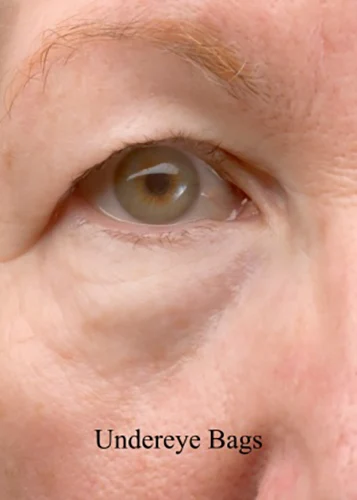
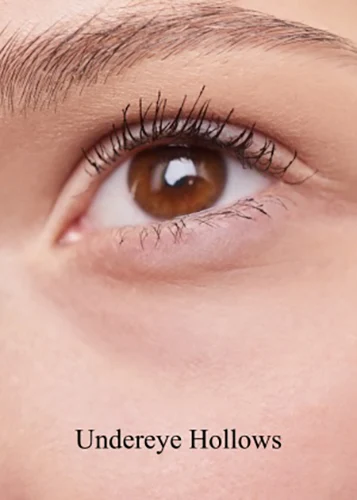

Volume Loss & Tear Trough Hollowing
The tear trough is the area directly beneath the eyelid, extending from the inner corner of the eye to the mid-pupil.[3] As we age, changes in the bones, ligaments, and fat pads around the eyes can cause this area to lose volume and appear sunken. Specifically, the bone of the lower part of the eye socket recedes, the cheekbone rotates backwards, the deep fat pads shrink, and the superficial fat pads descend down the face. These changes increase tension on the tear trough ligament, pulling the skin down and creating a noticeable groove between the lower eyelid and the cheek.[4] This groove causes shadowing, making the under-eye area look aged.
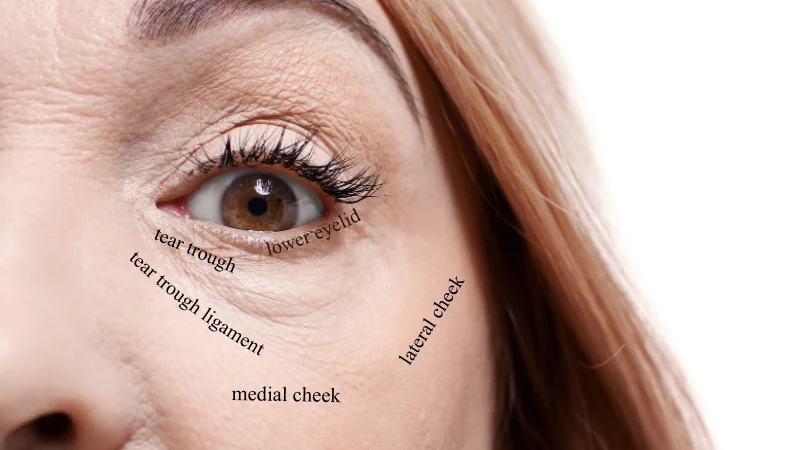
Anatomy of the under-eye area — tear trough, ligament, & cheek structures
Under-Eye Bags & Puffiness
Under-eye bags can be caused by fluid retention in the eyelids or by bulging of the fat pads within the eye socket.[5] Tissue puffiness can be caused by excess salt intake, seasonal allergies, or impaired lymphatic drainage. Protrusion of the under-eye fat pads is not fully understood but thought to relate to weakening of the tissue separating the contents of the eye socket from the rest of the face. Furthermore, volume loss in the anterior cheek can exaggerate the appearance of both protrusion and swelling, creating the same effect, increased under-eye darkness, and an aged appearance.
Skin Quality
Eyelid skin is some of the thinnest skin of the body.[4] Given its delicate nature, changes in the skin are accentuated in the area. As we age, collagen and elastin decline, leading to laxity and a crepey, wrinkled under-eye appearance. When crepiness is the primary undereye concern, dermal filler is not the best first-line treatment. Treatments that stimulate collagen or tighten the skin are often more appropriate in these cases.
Important Note
Pigmentation & Vascular Tone
Under-eye darkness can also be caused by increased pigmentation in the under-eye area. Because the under-eye skin is thin, with virtually no subcutaneous fat [4], underlying blood vessels can show through, creating a purplish appearance. In addition, hyperpigmentation, brown discoloration of the under-eye skin, can be caused by hormonal changes, medications, UV light exposure, and inflammation (such as from chronic allergies).[4]
Increasing collagen production in this area can thicken the skin, reducing this vascular visibility. Laser therapy can also be an effective treatment for hyperpigmentation, often providing favorable and long-lasting results.[6]
Facial structure & midface support
As the face ages, we all lose support and structure in the mid-face, the lateral and anterior portions of the cheek. This results in descent of facial tissue around the eyes, new lines and folds around the nose and mouth, and sagging along the jawline. Restoring support in the lateral cheek, projection in the anterior cheek, and volume in the deep fat pads can help reverse or slow some of these changes, creating a more balanced, youthful, and refreshed appearance.
TREATMENT OPTIONS
What under-eye filler is Designed to do
Under-eye filler is designed to soften shadows and reduce the appearance of darkness by restoring lost volume and structural support, creating a smoother, more seamless transition from the lower eyelid to the cheek.
Dermal fillers are composed of hyaluronic acid (a sugar molecule) and are FDA-approved medical devices used to help create a smoother appearance in the face.[7] Hyaluronic acid dermal fillers have been in use for over 20 years and during that time have shown a favorable safety profile with minimal adverse events.
Key Insight
Tear trough filler is rarely about simply filling the hollow under the eye. In most cases, only a small amount of filler is injected in the tear trough itself. The real impact comes from treating surrounding support areas, such as the cheeks and sometimes the temples, which help lift and smooth the entire under-eye region.
A recent review of dermal fillers for tear trough rejuvenation found a high degree of patient satisfaction (85-90%) and an average duration of results for 10 to 14 months.[8]
To be noted, tear trough filler is rarely about simply filling the hollow under the eye. In most cases, only a small amount of filler is injected in the tear trough itself. The real impact comes from treating the surrounding support areas, such as the cheeks and sometimes the temples, which help lift and smooth the entire under-eye region.
What dermal fillers do well
Dermal filler is great at instantly restoring lost volume and projection, thereby smoothing under-eye contour irregularities that cause shadowing and the appearance of bags. Filler alone can create a dramatic improvement in under-eye dark shadows.

Before | After
Under-eye filler addressing hollowing & dark circles
What filler cannot reliably fix
Dermal fillers cannot correct skin pigmentation or significantly improve thin, lax, or crepey skin. Undereye darkness caused by hyperpigmentation requires pigment-targeted treatments such as lightening creams, lasers, or chemical peels.[4]
Lax skin is better addressed with collagen-stimulating treatments such as radiofrequency and laser therapies. Given the delicate nature of the under-eye skin, one should consult with an expert in these treatments to minimize the risk of side effects. Lower eyelid surgery or blepharoplasty should be considered in cases of severe skin laxity.[4]
When under-eye filler is usually a no
Under-eye filler isn’t the right solution for everyone. Patients with prominent under-eye fat pads, persistent swelling, or significant skin laxity may not get noticeable improvement, and the area may even appear worse after treatment. In these cases, a consultation with a board-certified plastic surgeon to discuss eyelid surgery (blepharoplasty) is often the most appropriate option. Eyelid surgery can provide long-lasting, noticeable improvement by directly addressing excess fat and skin.[9] It’s important to understand that while surgery results are durable, the aging process continues, and some individuals may require additional procedures to maintain optimal results.
What the evidence says
A 2022 systematic review by Trinh and colleagues examined the use of dermal fillers for tear trough rejuvenation in 2,048 patients. Overall patient satisfaction with tear trough filler was high, consistently reported at 85–90% across the reviewed studies.[8] Side effects reported were generally mild and included transient swelling and bruising at the injection site. The Tyndall effect, a bluish discoloration in areas of superficial filler injection, was observed in 3% of patients. Contour irregularities following injection were rare. Overall, 4% of patients required treatment with hyaluronidase to dissolve and improve irregularities. The treatment duration ranged from 10 to 15 months.
Another systematic review from 2023 by Liu and colleagues evaluated the effectiveness and safety of hyaluronic acid injections (dermal fillers) for the tear trough, including 2556 patients. They found a pooled satisfaction rate of 91% and higher patient satisfaction when <0.5ml was injected per side. Adverse events in their study were similar to those in the study by Trinh, with swelling (19%), bruising (18%), and redness (5%). The Tyndall effect occurred at a rate of 0.9%.[3]
Safety, skill, & why the under-eye is different
While injectable treatments have evolved significantly from early materials like paraffin wax and fat injections, today’s hyaluronic acid (HA) fillers, especially when used around the eyes, are still not without risk [11]. The periocular region is complex, highly vascular, and unforgiving, making proper technique and patient selection critical.
This is not an area where shortcuts or inexperience belong, as it is one of the hardest to achieve natural, safe results.
Why technique & anatomy matter more here
Given the very thin skin and delicate nature of the under-eye area, the injection technique and amount of product used must be precise to achieve natural results and minimize adverse events. The vascular anatomy of the under-eye is complex, with blood vessels in this area connecting with the vessels of the retina. Inadvertent injection into a blood vessel could lead to severe complications such as skin necrosis, vision loss, or stroke.[10] This is not an area where shortcuts or inexperience belong, as it is one of the hardest to achieve natural, safe results.
Common side effects vS. rare but serious risks
While dermal filler treatments are one of the safest cosmetic treatments available, with nearly 30 years of use, there are still potential complications.[12] Most filler-related side effects are mild and temporary, including redness, swelling, and bruising at injection sites. Moderate complications can include bluish discoloration under the skin from improper placement and, rarely, small nodules caused by an immune response. Both can typically be corrected safely by dissolving the filler. Rare but serious complications can occur, including skin injury, vision loss, or even stroke.[10,13] These outcomes, while uncommon, highlight why under-eye filler should only be performed by highly trained, experienced providers who have an advanced understanding of facial anatomy and are prepared to prevent, recognize, and manage complications.
What a responsible provider evaluates before treating
It is important to understand that having dermal fillers injected is a medical procedure and should be performed only in a medical office by a qualified healthcare provider.[12] A responsible provider carefully evaluates multiple factors before treating with dermal fillers. They should review your medical history and evaluate your facial features to ensure dermal filler is the right treatment option for you. They should discuss the risks, benefits, and expected outcomes of the procedure to ensure you fully understand all aspects of the plan. Your provider should confirm that only FDA-approved products are being used for injection and that the treatment is appropriate for the specific area being treated.[13] This thorough, safety-first approach is essential to achieving natural results while minimizing risk.
COMPARING YOUR OPTIONS
Under-eye filler VS. surgery
Dermal filler to treat under-eye darkness is not always the best option, and sometimes alternative treatments, such as eyelid surgery (blepharoplasty), are more likely to yield optimal results.
| Factor | Dermal Filler | Blepharoplasty |
|---|---|---|
| Best for | Volume loss, tear trough hollowing, mild shadows | Excess lax skin, large bulging fat pads |
| Invasiveness | Minimally invasive (injection) | Surgical procedure |
| Downtime | Minimal, most return to normal immediately | ~2 weeks recovery |
| Duration | 10 to 15 months | Long-lasting (years) |
| Reversible | ✓ Dissolvable with hyaluronidase | ✗ Permanent |
| Cost structure | Lower upfront, ongoing maintenance | Higher upfront, less maintenance |
Lower Blepharoplasty
Blepharoplasty is indicated for patients with moderate to severe excess lax skin and/or large bulging fat pads from the eye-socket. Blepharoplasty removes the excess skin and/or fat from the eyelids and can be done on either the upper or lower eyelid. The procedure is typically performed as a same-day surgery where you go home to recover after surgery, with about a two-week recovery anticipated.[14] Compared to a dermal filler treatment, blepharoplasty is a more invasive procedure, with greater risk and longer downtime, but for some patients may be required to adequately address the causes of under-eye darkness.
Fat Transfer
Autologous fat grafting is a minimally invasive technique by which surgeons extract your own fat from the hip, abdomen, or inner thigh and process it to allow it to be reinjected into areas of volume loss. A 2021 systematic review by Yang and colleagues evaluated the safety and efficacy of autologous fat grafting to the periorbital area. They reviewed 39 studies including 4046 patients. Overall patient satisfaction was high at 91%, though surgeon satisfaction with the result was lower at 81%. Complications included edema, contour irregularity, bruising, and volume excess. Complication rates ranged from 6 to 23%. There was quite a bit of variability in the studies. There remains uncertainty regarding the expected duration of the treatment results from this procedure and the survival of the fat graft.[15] While autologous fat grafting holds potential as a treatment for under-eye hollows, there is still much work to do to standardize the procedure and help quantify expected results and the duration of effect.
Non-filler alternatives
Not every under-eye concern requires dermal fillers or surgery. For patients looking to improve under-eye darkness or mild puffiness without injections or surgery, there are several effective options.
Skincare Options
Concealer is the least invasive option for treatment of under-eye darkness, and minimal makeup can be used to blend the skin tone and conceal the darker under-eye appearance. Optical diffusers, such as titanium dioxide, are a useful ingredient addition to concealers. They work to reflect light away from the skin with differently sized particles, resulting in a smooth-looking surface.
Skin-lightening agents such as Hydroquinone and Kojic acid work by decreasing melanin production, resulting in reduced pigmentation in the local area where they are applied.[4]
Lasers & pigmentation
Under-eye darkness is primarily caused by one of two mechanisms: either shadows cast by surrounding facial structures or increased pigmentation of the under-eye skin. Dermal fillers are effective in treating most causes of structural shadowing. However, lasers and chemical peels are likely the best options when under-eye darkness is caused by increased skin pigment. Due to the delicate nature of under-eye skin, these procedures should be approached with caution and performed only by an experienced medical provider. Chemical peels remove superficial layers of skin and, with them, the melanin that causes increased pigmentation.[4] There are a variety of laser technologies that target various contributors to skin hyperpigmentation. Some lasers use specific wavelengths of light to target melanosomes or hemoglobin. Other lasers work to resurface the skin by ablating the top layers. During the body’s repair process, new layers of skin are formed with increased collagen and decreased pigmentation and wrinkles. The recovery time following an ablative laser procedure can be significant.[4]
MAKING YOUR DECISION
Expectations, maintenance, & “true cost” over time with Dermal Fillers
When deciding whether dermal fillers are right for you, results and cost are often the biggest considerations. Keep in mind that with dermal fillers, the initial investment is higher than the cost of maintenance visits and significantly less than the cost of surgery. In addition, dermal fillers offer a customizable, gradual approach to facial rejuvenation. Understanding what fillers can and cannot do helps ensure you’re happy with your results and your long-term maintenance plan.
What a good result looks like
Great under-eye dermal filler results should make you look refreshed, rested, and naturally radiant, not “done.” The goal is subtle improvement that enhances your features without changing how you look. Friends may say you look well-rested or glowing, but they likely will not ask what procedure you had.
With areas like the under-eyes, filler doesn’t completely erase hollows or bags, but it softens shadows and creates smoother transitions. You will still look like yourself and still look your age, just healthier, brighter, and more balanced. Dermal fillers are about refinement, not perfection or an airbrushed appearance.
Dermal fillers are about refinement, not perfection or an airbrushed appearance.
Before | After
Softening under-eye shadows & volume imbalance.
Before | After
Restoring structure to reduce under-eye darkness.
Dermal Filler Maintenance
The initial filler appointment is often the most costly because it focuses on restoring structural support that has been lost over time, such as fat pad volume and changes in bone structure. This phase requires more product to rebuild a foundation [7].
Maintenance treatments are usually smaller and less expensive. Many patients need fewer syringes for upkeep, often one or two instead of five or six. While fillers do gradually metabolize, small amounts may remain longer than previously thought, making long-term maintenance more cost-effective.
Downtime & lifestyle considerations
One of the biggest advantages of dermal fillers is the minimal downtime. Most patients return to normal activities immediately, with only mild swelling or bruising possible. Compared to surgical options, fillers offer a far more flexible recovery and easily fit into a busy lifestyle.
What a consultation at Aluma looks like
When it comes to under-eye bags, a thorough medical consultation is essential. The under-eye area is one of the most anatomically complex regions of the face, and successful treatment begins with understanding the true cause of your concern, whether it’s volume loss, hyperpigmentation, skin laxity, fat bulging, or a combination of factors.
At Aluma, consultations are conducted by Dr. Nathaniel Brigham, MD, a board-certified physician with over 20 years of experience in medicine and 8 years dedicated to aesthetic medicine. During your visit, he will take detailed photographs, measurements, and discuss your concerns to determine the most appropriate treatment options. Together, you will create a plan of care to reach optimal results.
Dr. Brigham’s approach to medical aesthetics is educational, transparent, and individualized.
Physician-led injectables & anatomy-based planning
Your consultation begins with a comprehensive assessment and education on how aging uniquely affects your anatomy, ensuring every treatment is guided by your facial structure for the most natural results. The under-eye area is one of the most complex regions of the face, shaped by the orbital bone and ligaments, the tear trough, surrounding muscles, fat pads, lymphatic channels, and the skin itself. Each of these elements influences contour, light reflection, and overall appearance, which is why an in-depth anatomical understanding is essential to selecting the right approach and achieving a refreshed, youthful look.
Conservative approach & combination planning when appropriate
When appropriate, a conservative, layered strategy delivers the most natural and refined results. Many patients benefit from a staged treatment plan that may combine biostimulators and dermal fillers to gradually support collagen production, restore structure, and enhance the under-eye area. This approach prioritizes subtle improvement over overcorrection, creating balanced, long-lasting rejuvenation that looks refreshed, not treated.
Next steps & follow-up expectations
You’ll leave with a clear, fully customized treatment plan, transparent financing options, and detailed pre- and post-treatment care instructions, so you feel informed, prepared, and supported every step of the way.
FAQs
Ready for a Personalized Consultation?
Conclusion
The under-eye area is delicate, complex, and highly individualized, which is why proper diagnosis and expert technique matter so deeply. When placed expertly, dermal filler for the undereyes softens, refreshes, and restores balance without ever looking obvious or overdone.
At Aluma Aesthetic Medicine, our philosophy is rooted in education, safety, and long-term results. We believe the best outcomes come from honest conversations about what filler can achieve, when surgery may be more appropriate, and how a staged or combination approach can create the most natural transformation.
Whether your plan includes dermal fillers, biostimulators, or a referral for surgical care, our goal is always the same: to guide you toward the treatment that truly serves your anatomy and your best outcome.
References [1–15]
-
Barton JJ, Radcliffe N, Cherkasova MV, Edelman J, Intriligator JM. Information processing during face recognition: the effects of familiarity, inversion, and morphology on scanning fixations. Perception. 2006;35(8):1089-1105.
-
Nguyen HT, Isaacowitz DM, Rubin PA. Age- and fatigue-related markers of human faces: An eye-tracking study. Ophthalmology 2009; 116:355-360.
-
Liu, Xuanchen, et al. “The Efficacy and Safety of Hyaluronic Acid Injection in Tear Trough Deformity: A Systematic Review and Meta-Analysis.” Aesthetic Plastic Surgery (2024); 48: 478–490.
-
Vrcek I, Ozgur O, Nakra T. Infraorbital dark circles: a review of the pathogenesis, evaluation, and treatment. J Cutan Aesthet Surgery 2016; 9: 65-72.
-
AAO — Bags Under the Eyes (patient education). https://www.aao.org/eye-
health/tips-prevention/bags- under-eyes -
Roohaninsab, Masoumeh, et al. “Effects of laser therapy on periorbital hyperpigmentation: a systematic review on current studies.” (2021); 36:1781-1789.
-
FDA — Dermal Fillers (Soft Tissue Fillers) https://www.fda.gov/medical-
devices/aesthetic-cosmetic- devices/dermal-fillers-soft- tissue-filler -
Trinh LN et al. (2022) — Dermal Fillers for Tear Trough Rejuvenation (systematic review)
-
ASPS — Eyelid Surgery overview + Safety page https://www.plasticsurgery.
org/cosmetic-procedures/ eyelid-surgery -
AAO EyeNet. Safety Update: Periocular Dermal Fillers (2020) https://www.aao.org/eyenet/
article/safety-update- periocular-dermal-fillers -
FDA — FDA-Approved Dermal Fillers https://www.fda.gov/medical-
devices/aesthetic-cosmetic- devices/fda-approved-dermal- fillers -
AAD — Fillers: FAQs. https://www.aad.org/public/
cosmetic/wrinkles/fillers-faqs -
FDA. Dermal Filler Do’s and Dont’s https://www.fda.gov/consumers/
consumer-updates/dermal- filler-dos-and-donts-wrinkles- lips-and-more -
Mayo Clinic — Blepharoplasty https://www.mayoclinic.org/
tests-procedures/ blepharoplasty/about/pac- 20385174 -
Yang F, Ji Z, Peng L, Fu T, Liu K, Dou W, et al. (2021) Efficacy, safety and complications of autologous fat grafting to the eyelids and periorbital area: A systematic review and meta-analysis. PLoS ONE 16(4): e0248505.
-
