

If your under-eyes look hollow, dark, puffy, or tired, it is easy to assume there’s one treatment for the problem. Under-eye filler is often the first option people encounter, especially when searching online or looking at before-and-after photos.
But what you see in the mirror doesn’t necessarily tell you what is causing it.
The appearance of dark under-eye circles may stem from one of several causes including increased skin pigmentation, thin skin due to collagen loss, visible blood vessels, shadows created by volume loss and hollowing, bags caused by prominent fat under the eye, under-eye tissue swelling, loss of cheek support, or a combination of factors.
Distinguishing between these causes matters because filler can work very well for the right structural problem, but it is not the right tool for every under-eye concern.
The question you should ask yourself is this: what is creating your concern, and which treatment best addresses that cause?
Under-Eye Concerns Don’t All Have the Same Cause
The under-eye area is complex. Skin, fat, ligaments, muscles, bones, blood vessels, and the transition into the cheek all contribute to what we see.
Research on infraorbital dark circles describes the key players in this process, including increased skin pigmentation, skin laxity and wrinkles, visible underlying blood vessels, shadowing due to hollowing, and fat loss in some areas while becoming more prominent in others. More than one cause is often present at the same time.
This is why two people can both describe having “dark circles” while having very different underlying issues.
Adding volume can soften a shadow caused by a hollow. It cannot remove pigment from the skin. Treating pigmentation will not rebuild lost facial support. And adding filler to an area that is already full or persistently puffy may not improve the concern at all.
What's Actually Creating the Hollow, Darkness, or Bag?
Before considering treatment, it helps to understand several common patterns.
The tear trough is the groove that can develop between the lower eyelid and upper cheek. Changes in facial volume and support can make this transition more visible, creating a hollow that catches light differently from the surrounding tissue.
That shadow can make the area look darker even when the skin itself is not significantly pigmented.
This is one situation where hyaluronic acid filler may be useful.
A visible under-eye “bag” is not necessarily the same thing as a hollow.
Fat within the eye socket can press out on the lower eyelid and become more prominent, while surrounding areas may simultaneously lose volume. That combination can create a noticeable transition between fullness above and a groove below.
In some people, modest structural correction in the groove below can smooth that transition. Very prominent fat pads, however, may be better addressed surgically rather than by adding volume with dermal filler.
Under-eye fullness can also involve fluid retention or edema rather than structural fat alone.
This distinction matters because adding filler to an area that already tends to retain fluid may increase fullness instead of improving it. Persistent puffiness therefore requires careful evaluation before considering injectable treatment.
Not all dark circles are shadows.
Brown discoloration may come from increased skin pigmentation. Thin lower-eyelid skin can also allow underlying vascular color to show through, creating a blue or purple appearance in the under-eye.
These concerns require different treatment thinking because adding volume does not directly remove pigment or change every vascular source of discoloration. In some cases a very thin flexible filler can be placed superficially between the skin and the deeper blood vessels to create more barrier so the color of the blood vessels does not show through as much.
The skin around the eyes is particularly thin, so changes in collagen, elasticity, and texture can become noticeable quickly.
Fine lines, crepiness, and laxity are skin-quality concerns. Filler may improve the contour beneath that skin when volume loss is also present, but filler itself is not a skin-tightening or pigment-correcting treatment.
When Under-Eye Filler Can Help
Hyaluronic acid filler is most useful when structural hollowing or volume loss is contributing significantly to the appearance of the under-eye area.
In an appropriately selected patient, filler can soften the transition between the lower eyelid and cheek, reduce the appearance of a tear-trough groove, and decrease shadowing created by that contour difference.
The evidence for hyaluronic acid treatment of tear-trough deformity is generally favorable. A 2024 systematic review and meta-analysis involving 31 reports and 2,556 participants found an overall patient satisfaction rate of about 91 percent.
That does not mean filler is appropriate for everyone with dark circles or tired-looking eyes.
It also does not mean the objective is to completely erase the tear trough. Under-eye filler is an area where conservative treatment matters. The aim is usually to create a smoother transition and softer shadow while preserving natural facial contours.
A successful result should still look like you. The change may be most noticeable as a less hollow, less shadowed, or more rested appearance rather than an obviously “filled” under-eye.
Why the Cheeks and Midface May Matter More Than You Think
The lower eyelid transitions directly into the cheek. When support and volume in the cheek decreases, that change can make the under-eye groove look deeper and the separation between the eyelid and cheek more obvious.
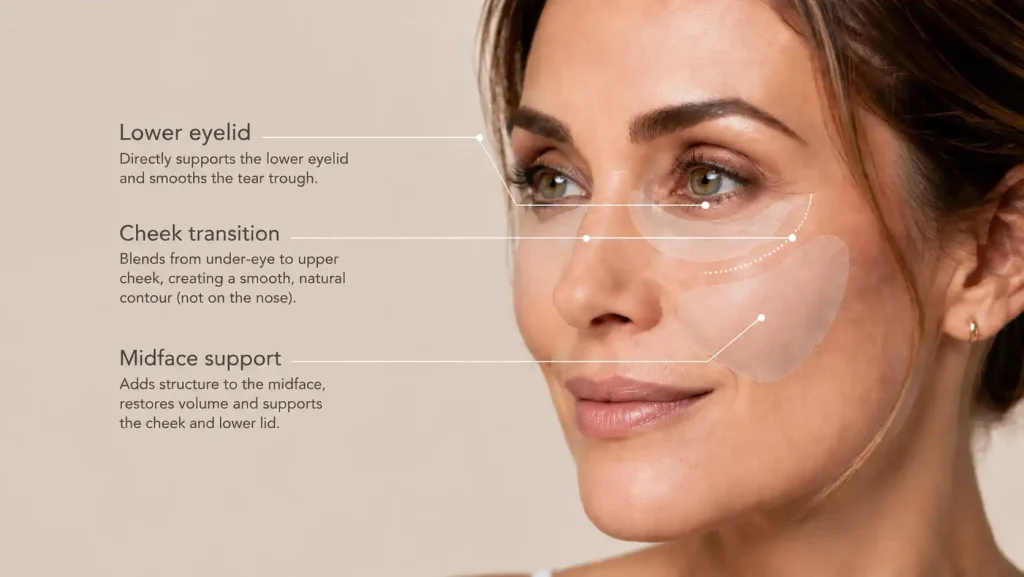
For many patients, improving lateral support and projection in the cheek can create a smoother transition beneath the eye. It may also reduce the amount of correction needed directly within the tear-trough area.
Recent clinical literature supports this anatomy-based approach. Treatment algorithms for the tear-trough and eye-bag complex include assessing the cheek and zygomatic region as part of treatment selection, rather than automatically treating only the visible groove. More recent reviews also emphasize evaluating midface volume loss before direct infraorbital correction.
At Aluma, this broader structural assessment is an important part of treatment planning. We look at how the under-eye relates to the cheek and surrounding facial anatomy rather than assuming that every hollow needs to be filled directly.
That does not mean everyone needs cheek filler before under-eye treatment. It means evaluating the whole support system before deciding where treatment belongs.
When Filler Is Probably Not the Right Treatment
Filler may be a poor choice when the primary concern is:
- Significant increased skin pigmentation
- Thin or crepey skin without meaningful volume loss
-
Substantial skin laxity
-
Persistent swelling or puffiness under the eyes
Current reviews of tear-trough treatment emphasize patient selection. Hyaluronic acid filler is generally better suited to mild structural deformity in patients with favorable skin quality and limited laxity or fat herniation, while more significant anatomical changes may require a surgical approach.[6]
Sometimes the best filler decision is deciding not to use filler.
What Other Treatment Options May Address
When filler is not the right tool, the next question is what are the best treatment options based on the suspected causes of the under-eye darkness.
When darkness is primarily pigment-related, treatment may include pigment-focused skincare, carefully selected chemical peels, or laser and light-based treatments depending on skin type and the nature of the discoloration. Reviews of periorbital hyperpigmentation emphasize matching treatment to the specific cause rather than treating all dark circles the same way.[7]
Crepey texture, fine lines, and laxity should lead to consideration of treatments intended to improve collagen or skin quality rather than simply restoring volume.
In these situations, lower blepharoplasty may be more appropriate because surgery can directly address structures that filler cannot remove. Surgical evaluation becomes especially relevant as fat prominence and laxity increase.
Hyaluronic acid filler remains an important option when volume loss and contour are the primary problems.
Safety and What Makes the Under-Eye Area Different
The under-eye region deserves particular care because the tissues are thin, contours are highly visible, and the vascular anatomy is complex.
Common effects after hyaluronic acid tear-trough treatment include swelling and bruising. In the 2024 meta-analysis, pooled rates were approximately 19 percent for swelling or edema and 18 percent for bruising. Contour irregularities and bluish discoloration known as the Tyndall effect occurred less frequently.[3]
Dermal fillers also carry rare but serious risks. The FDA warns that unintended injection into a blood vessel can interrupt blood flow and may lead to tissue injury, vision impairment or blindness, and stroke.
Those risks are uncommon, but their potential severity is one reason why patient selection, in depth knowledge of anatomy, a conservative technique, and preparation to recognize and manage complications matter.
Treat under-eye filler as a medical procedure, not simply a cosmetic product.
How to Think About the Right Treatment for Your Under-Eyes
The visible concern is only the beginning.
Is darkness coming primarily from a shadow or from pigment?
Is a bag caused by fat prominence, tissue puffiness, loss of surrounding support, or a combination of factors?
Is the hollow isolated beneath the eye, or is broader midface volume loss contributing to the transition?
Is texture the real concern rather than volume?
At Aluma, we evaluate the anatomy first, then determine which treatment, if any, addresses the structures creating the concern. Sometimes that means filler. Sometimes supporting the surrounding midface matters more. Sometimes a skin-focused treatment makes more sense. And sometimes the right recommendation is a surgical evaluation rather than another injectable treatment.
The objective is not to find a way to use filler. It is to choose the best pproach that fits the problem you are actually trying to solve.
References
- Vrcek I, Ozgur O, Nakra T. Infraorbital Dark Circles: A Review of the Pathogenesis, Evaluation and Treatment. J Cutan Aesthet Surg. 2016;9(2):65-72.
- Beer J, et al. What’s New With Under-Eye Treatment: A Multispecialty Systematic Review of Recent Under-Eye Treatments. Dermatol Surg. 2026.
- Liu X, Gao Y, Ma J, Li J. The Efficacy and Safety of Hyaluronic Acid Injection in Tear Trough Deformity: A Systematic Review and Meta-analysis. Aesthetic Plast Surg. 2024;48(3):478-490.
- Peng PH, et al. Treating the Tear Trough-Eye Bag Complex: Treatment Targets, Treatment Selection, and Injection Algorithms With Case Studies. J Cosmet Dermatol. 2020.
- Optimizing Infraorbital Hollows Treatment With Hyaluronic Acid Fillers: Overview of Anatomy, Injection Techniques, and Product Considerations. Aesthet Surg J. 2025.
- Tear Trough Deformity: Update on Anatomy and Clinical Management. 2026.
- Friedmann DP, et al. Treatments of Periorbital Hyperpigmentation: A Systematic Review. Dermatol Surg. 2021.
- U.S. Food and Drug Administration. Dermal Fillers (Soft Tissue Fillers): Risks and Safety Information.
